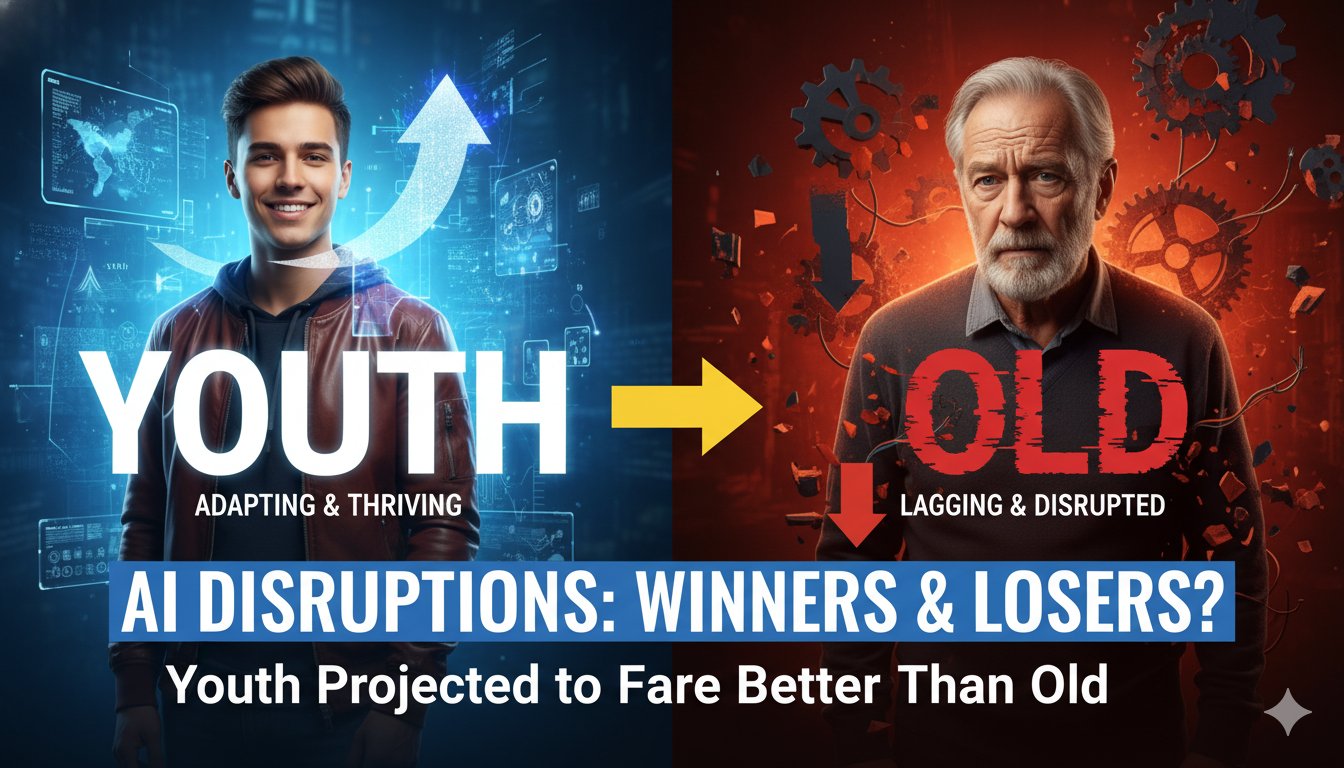
*”Recent analyses from major investment banks indicate that workers under 30 are positioned to adapt more effectively to AI-driven changes in the job market by switching careers and acquiring new skills, while older workers could experience the most significant earnings reductions and wealth vulnerabilities if an AI investment bubble bursts.” *
Projections show that artificial intelligence is set to reshape the U.S. labor market, with varying impacts across age demographics. Analysts estimate that AI could automate tasks equivalent to 300 million full-time jobs globally, potentially boosting U.S. GDP by up to 7% through enhanced productivity. However, this transformation carries uneven risks, particularly for those in cognitive-task-heavy roles.
Differential Impacts by Age Group
Younger workers, especially those under 30, are expected to navigate these shifts more successfully. Their flexibility allows for easier career pivots into emerging AI-augmented fields, such as machine learning engineering or data ethics roles, where demand is surging. Entry-level positions in high-exposure occupations like software development and customer service have already declined by around 6% for 22- to 25-year-olds since late 2022, but this group’s ability to reskill rapidly—through online platforms and accelerated training programs—positions them for recovery and growth in new opportunities.
In contrast, older workers face steeper challenges. Those over 50, often in managerial or specialized roles, may encounter the highest earnings losses, projected at up to 15-20% in disrupted sectors. This stems from reduced adaptability to new technologies and longer tenure in vulnerable jobs, such as administrative support or credit analysis, where AI automation is advancing quickest.
Wealth Implications and Bubble Risks
| Age Group | Projected Earnings Impact | Key Factors |
|---|---|---|
| Under 30 | Minimal long-term loss (potential net gain) | High adaptability, skill acquisition ease, career mobility |
| 30-50 | Moderate decline (5-10%) | Balanced experience but need for upskilling |
| Over 50 | High decline (15-20%) | Limited flexibility, equity exposure risks |
Beyond employment, AI’s economic ripple effects extend to personal wealth. Older Americans typically hold larger equity portfolios, making them more susceptible to market corrections. If the current surge in AI investments—fueled by massive funding rounds exceeding $75 billion quarterly—proves unsustainable, a correction could erode retirement savings disproportionately. Equity-heavy sectors like semiconductors and cloud computing, valued at trillions, amplify this vulnerability for those nearing retirement.
Younger cohorts, with smaller asset bases and longer investment horizons, are less exposed to such volatility. Their focus on skill-building over asset accumulation aligns with a labor market where AI integration is linked to 56% wage premiums in adopting industries.
Sector-Specific Disruptions
Certain U.S. industries highlight these generational divides. In tech, software engineers under 30 are adapting by specializing in AI agents, while mid-career professionals see routine coding tasks automated. Finance roles like credit analysts face 25% task automation, hitting experienced workers harder. Manufacturing, already down 2 million jobs to AI by projections, favors younger entrants trained in robotics over veterans in legacy processes.
Overall, while AI promises a net job creation of 78 million globally by 2030, the transition favors agility. U.S. firms planning workforce reductions of 41% due to automation are simultaneously hiring for AI-savvy roles, creating a divide where youth’s adaptability translates to economic resilience.
Disclaimer: This news report provides general information and tips based on publicly available sources and is not intended as financial advice or investment recommendations.