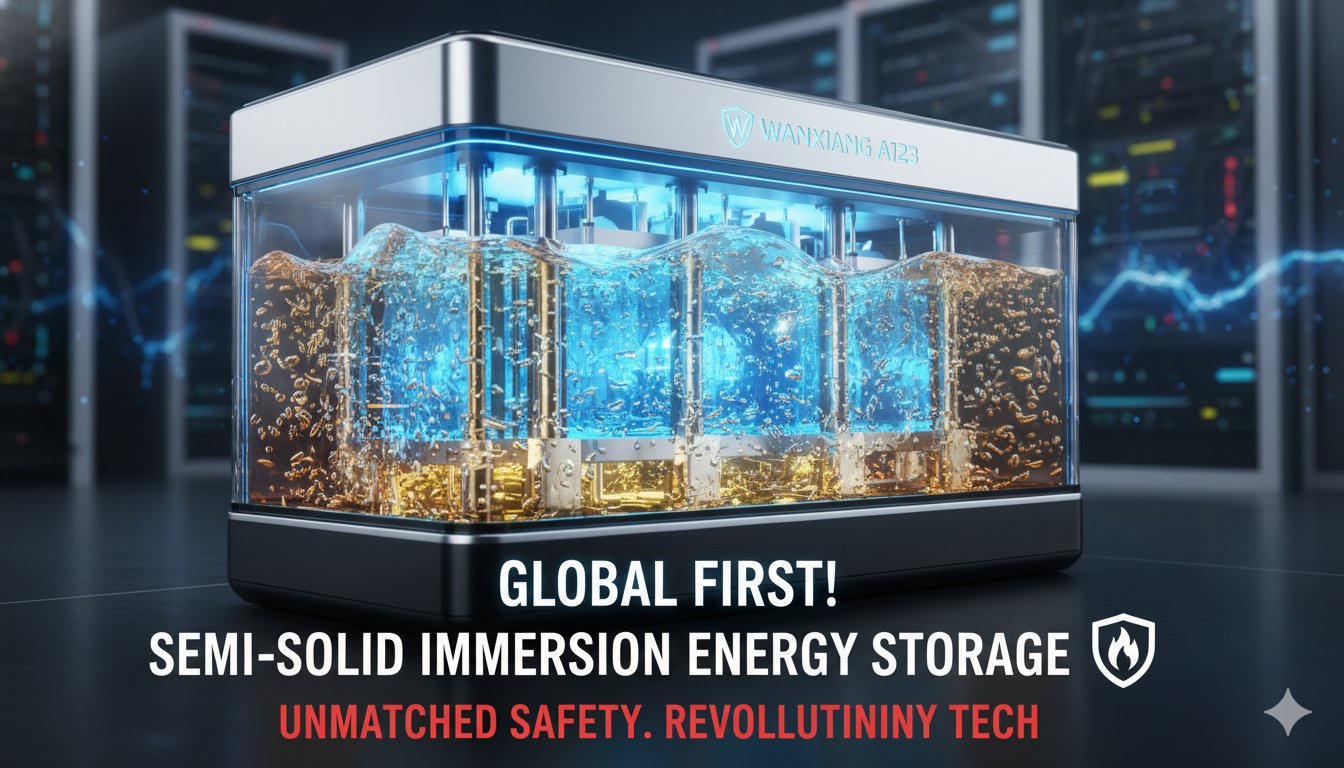
“Wanxiang A123 has introduced a pioneering energy storage platform that integrates semi-solid-state battery cells with immersion cooling technology, achieving zero thermal runaway in rigorous tests and positioning the company to capture a larger share of the booming global market projected to exceed $500 billion by 2035.”
In the competitive landscape of energy storage, where safety concerns have long plagued large-scale deployments, Wanxiang A123’s latest innovation marks a significant leap forward. The Star Series semi-solid-state battery cells represent a core advancement, utilizing a proprietary electrolyte composition that blends solid and liquid properties to enhance ion conductivity while minimizing volatility. This design inherently suppresses dendrite formation, a common precursor to short circuits in traditional lithium-ion batteries, and maintains structural integrity under extreme conditions. During demonstrations, a 100 Ah cell endured a 10-needle puncture test without igniting, smoking, or exploding, a feat that outperforms conventional cells which often fail catastrophically in similar scenarios.
Complementing these cells is the Star River Series, an immersion-based energy storage system that submerges battery modules in a non-conductive dielectric coolant. This approach eliminates uneven heat distribution across cells, a persistent issue in air-cooled or liquid-plate systems, by allowing direct contact between the coolant and cell surfaces. In the event of a localized failure, the coolant rapidly absorbs and dissipates heat, preventing propagation to adjacent cells. System-level efficiency gains include a 20% improvement in thermal management compared to legacy technologies, enabling higher energy densities without compromising reliability. The integration of these elements creates the world’s first semi-solid-state immersion platform, tailored for utility-scale applications where downtime and risks can translate to millions in losses.
From a materials perspective, the Star Series incorporates advanced cathode and anode formulations derived from Wanxiang A123’s nanoscale phosphate chemistry heritage. This not only boosts cycle life to over 5,000 full charges but also reduces reliance on scarce metals like cobalt, lowering production costs by an estimated 15% per kWh. The immersion cooling further extends system longevity by maintaining optimal operating temperatures between 20-30°C, even in high-ambient environments common in solar farms or data centers. For operators, this translates to reduced maintenance intervals and lower insurance premiums, as the platform’s safety profile mitigates liabilities associated with fire hazards.
Key Technical Specifications and Performance Metrics
To illustrate the platform’s advantages, consider the following breakdown:
Energy Density : Up to 280 Wh/kg at the cell level, surpassing many liquid-electrolyte competitors by 10-15%.
Cycle Life : Projected at 6,000-8,000 cycles with 80% capacity retention, ideal for daily grid balancing.
Safety Testing : Passed overcharge, short-circuit, and crush tests with zero thermal events; immersion cooling caps temperature rise at 50°C during faults.
Scalability : Modular design supports configurations from 1 MWh residential backups to 100 MWh utility installations.
Efficiency : Round-trip efficiency of 95%, minimizing energy losses in arbitrage applications.
These metrics position the system as a game-changer for sectors reliant on uninterrupted power, such as telecommunications and manufacturing, where even brief outages can disrupt operations costing upwards of $100,000 per hour.
Market Dynamics and Competitive Edge
The global energy storage sector is experiencing explosive growth, with battery installations surpassing 250 GW worldwide in 2025 and annual additions expected to exceed 130 GW in the current year. This surge is driven by the integration of renewables, where intermittent sources like wind and solar necessitate robust storage to stabilize grids. In the U.S., the market alone was valued at over $24 billion last year and is forecasted to reach $83 billion by 2035, fueled by incentives under federal programs aimed at decarbonization. Wanxiang A123’s platform addresses a critical pain point: thermal runaway incidents, which have led to recalls and project delays across the industry, eroding investor confidence.
Compared to rivals, this innovation outpaces air-cooled lithium-ion systems from companies like Tesla or LG Energy Solution, which, while cost-effective, have faced scrutiny over fire risks in large deployments. Solid-state alternatives from startups remain in prototyping phases, often struggling with scalability and high costs. By combining semi-solid-state benefits—such as improved energy density and safety—with immersion cooling’s practicality, Wanxiang A123 bridges the gap, offering a deployable solution that could accelerate adoption in high-stakes environments. For instance, in California’s volatile grid, where wildfires exacerbate safety demands, this technology could enable safer, denser storage farms, potentially unlocking billions in deferred infrastructure investments.
Financially, the platform’s lower total cost of ownership—estimated at $150-200 per kWh over a 20-year lifespan—makes it attractive for project developers. With global utility-scale cell shipments hitting 556 GWh last year and projected to climb to 801 GWh this year, Wanxiang A123 is well-positioned to expand its market share. The company’s North American operations, bolstered by local manufacturing, align with domestic content requirements, potentially qualifying for tax credits that enhance project economics. Investors eyeing the sector should note the ripple effects: enhanced safety could reduce risk premiums, attracting more capital to energy storage funds and ETFs, which have seen inflows topping $50 billion annually.
Sector-Specific Applications and Economic Impacts
In commercial and industrial segments, the system excels in peak shaving, where businesses store low-cost nighttime energy for daytime use, slashing demand charges by 30-40%. For data centers, a booming market with power needs projected to double by 2030, immersion cooling integrates seamlessly with existing liquid infrastructures, providing resilient backup against grid fluctuations. Healthcare facilities benefit from the platform’s reliability, ensuring critical equipment remains operational during blackouts, while logistics hubs can leverage it for EV charging stations, supporting the electrification of fleets.
Economically, widespread adoption could stimulate job creation in battery assembly and installation, with the U.S. sector already employing over 100,000 workers. On a macro level, by mitigating thermal risks, this technology supports the broader energy transition, where investments reached a record $2.3 trillion globally last year. Reduced incidents mean fewer regulatory hurdles, fostering faster permitting for gigawatt-scale projects. In emerging markets like Texas and Arizona, where solar proliferation outpaces grid upgrades, such systems could defer billions in transmission line expenditures, redirecting funds toward innovation.
Comparative Analysis of Battery Technologies
To contextualize Wanxiang A123’s offering, the following table compares key energy storage technologies:
| Technology | Energy Density (Wh/kg) | Cycle Life | Safety Rating (Thermal Runaway Risk) | Cost per kWh | Primary Applications |
|---|---|---|---|---|---|
| Traditional Lithium-Ion | 200-250 | 3,000-4,000 | Medium-High | $100-150 | EVs, Grid Storage |
| Solid-State | 300-400 | 5,000+ | Low | $250-300 | Prototypes, High-End |
| Semi-Solid-State (Wanxiang A123) | 260-280 | 6,000+ | Very Low | $150-200 | Utility, Commercial |
| Flow Batteries | 100-150 | 10,000+ | Low | $200-250 | Long-Duration Storage |
| Lead-Acid | 30-50 | 500-1,000 | Medium | $50-100 | Backup Power |
This comparison highlights the balanced profile of semi-solid-state with immersion, offering superior safety without the premium pricing of full solid-state options.
Strategic Implications for Stakeholders
For utilities, the platform enables arbitrage by storing excess renewable energy and releasing it during peak pricing, potentially yielding returns of 10-15% on invested capital. Developers can bundle it with solar or wind assets for hybrid projects, enhancing bankability through reduced operational risks. Insurers, long wary of battery fires, may lower premiums by 20-30% for certified installations, broadening accessibility for smaller operators. In the supply chain, the technology’s reduced material demands could ease pressures on lithium markets, where prices have fluctuated amid demand spikes.
Overall, Wanxiang A123’s launch underscores a shift toward safer, more efficient storage, essential for achieving net-zero goals. As deployments ramp up, the economic multipliers—from cost savings to innovation spillovers—could reshape the energy landscape, benefiting shareholders in related sectors.
Disclaimer: This news report is for informational purposes only and does not constitute financial tips or advice. Sources are not mentioned.