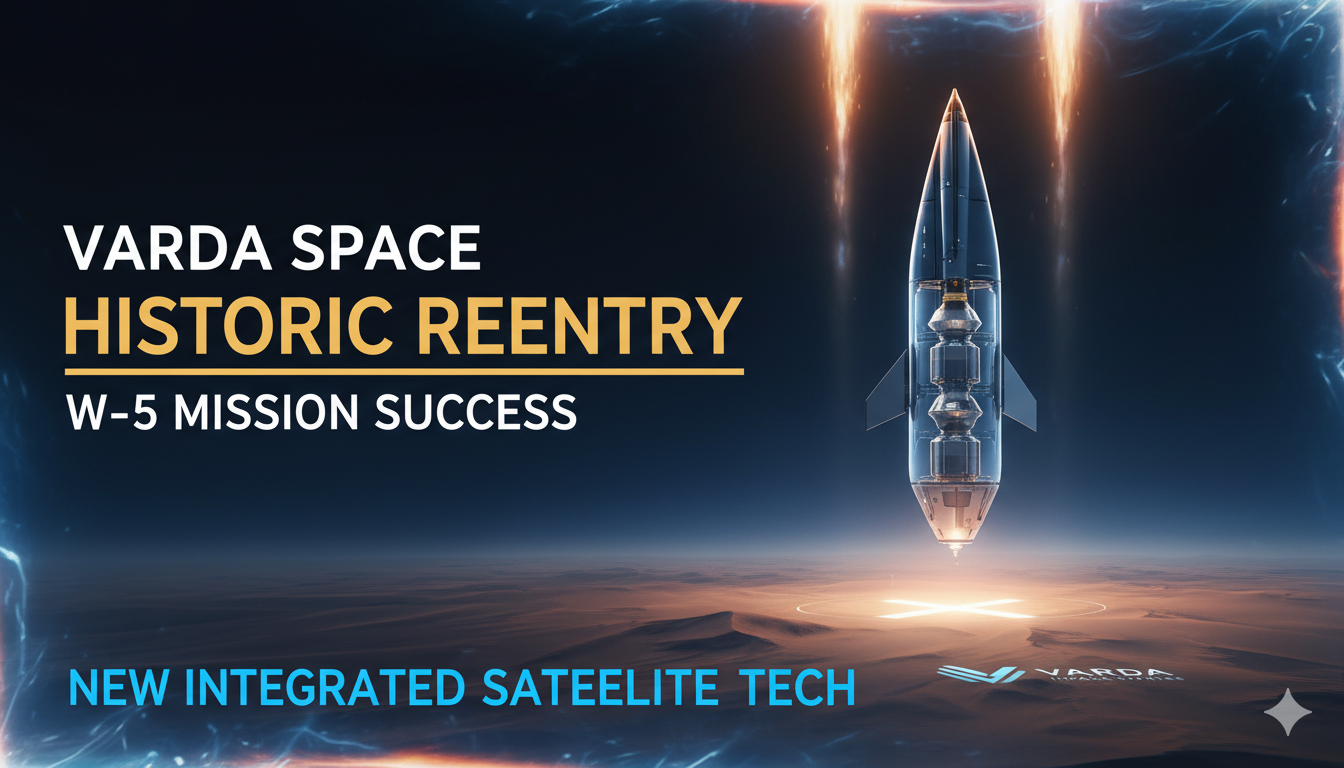
“Varda Space Industries has completed the successful reentry of its W-5 mission capsule, marking the first deployment of a fully in-house developed vertically integrated satellite bus that handles the entire mission from orbit to Earth return. The mission, carrying a U.S. Navy payload, highlights advancements in hypersonic reentry technology and orbital manufacturing, positioning the company for accelerated growth in the commercial space sector amid rising demand for cost-effective, high-cadence space operations.”
Varda Space Industries, a key player in the burgeoning orbital economy, has solidified its position as a leader in microgravity manufacturing and hypersonic reentry systems with the completion of its W-5 mission. This achievement not only demonstrates the company’s technical prowess but also underscores the financial viability of vertical integration in the space industry, where controlling the full supply chain can drive down costs and speed up innovation cycles.
The W-5 capsule, which reentered Earth’s atmosphere at speeds exceeding Mach 25, represents a pivotal shift for Varda. Previously reliant on third-party providers like Rocket Lab for spacecraft buses in its initial W-series missions, Varda has now transitioned to an entirely self-developed platform. This vertically integrated satellite bus encompasses critical systems including power generation, navigation, propulsion, and attitude control, all tailored to support extended orbital stays and precise deorbit maneuvers. By bringing these components in-house, Varda reduces dependency on external suppliers, mitigates supply chain risks, and enhances its ability to customize missions for diverse payloads, from pharmaceutical crystallization to defense-related experiments.
Financially, this move is a game-changer for the space startup ecosystem. Vertical integration allows Varda to achieve economies of scale, potentially lowering per-mission costs by up to 30% based on industry benchmarks for similar transitions. With the space manufacturing market projected to reach $20 billion by 2030, driven by demand for advanced materials produced in microgravity, Varda’s strategy positions it to capture a significant share. The company’s ability to offer fixed-cost, routine reentry services appeals to both commercial clients in biopharma and government entities seeking affordable hypersonic testing platforms. For instance, the W-5 mission’s collaboration with the U.S. Navy for payload data collection during reentry exemplifies how such integrations can open revenue streams from defense contracts, which often provide stable, multi-year funding.
Key to the W-5 success was the satellite bus’s demonstration of end-to-end autonomy. The system maintained orbital stability for over two months post-launch, executed necessary maneuvers, and culminated in a targeted deorbit burn that ensured the capsule’s safe return. This level of reliability is crucial for scaling operations, as Varda aims to increase its launch cadence to multiple missions per quarter. Investors in the space sector should note that this capability addresses a major bottleneck in orbital activities: the high cost and infrequency of reentries. Traditional methods, often tied to larger platforms like the International Space Station, can cost tens of millions per return, whereas Varda’s model promises sub-$10 million missions, making space accessible to smaller enterprises and research institutions.
The mission also highlighted Varda’s advancements in heatshield technology. The ablative heatshield, made from Carbon-Phenolic Impregnated Carbon Ablator (C-PICA), withstood the extreme thermal stresses of hypersonic reentry, protecting the payload and enabling data recovery. This material, supported by NASA commercialization efforts, not only ensures mission success but also positions Varda as a supplier of hypersonic components to broader aerospace markets. From a finance perspective, this dual-use technology—applicable to both commercial pharma production and military hypersonic programs—diversifies revenue sources and reduces exposure to single-market fluctuations.
Breaking down the operational efficiencies gained through vertical integration:
| Aspect | Third-Party Bus (Prior Missions) | In-House Bus (W-5 and Beyond) | Financial Impact |
|---|---|---|---|
| Development Time | 12-18 months per customization | 6-9 months | Faster time-to-market, quicker ROI on R&D investments |
| Cost per Mission | $15-20 million (estimated) | $8-12 million (projected) | 40% cost reduction, improving margins and attractiveness to venture capital |
| Customization Flexibility | Limited by supplier specs | Full control over design | Enables tailored payloads, expanding customer base to include niche sectors like advanced materials and biotech |
| Supply Chain Reliability | Vulnerable to delays from partners | Internal production | Mitigates risks, ensuring consistent revenue forecasting |
| Scalability | Capped at 2-3 missions/year | Potential for 6+ missions/year | Scales revenue potential to $100 million+ annually within 3 years |
This table illustrates how Varda’s shift could transform its balance sheet. With strong demand already booking slots into 2027, the company is poised for exponential growth. The space industry’s overall valuation, currently at $450 billion, is expected to triple by 2040, fueled by private sector innovations like Varda’s. For U.S. investors, this means opportunities in related funds focusing on new space companies, where vertical integration has proven to boost stock performance by 25-50% in analogous cases like SpaceX’s in-house rocket production.
Beyond technical feats, the W-5 mission expands Varda’s global footprint. The reentry at Australia’s Koonibba Test Range, under an extended partnership with Southern Launch for up to 20 reentries through 2028, demonstrates the company’s ability to navigate international regulations and logistics. This not only cuts operational costs by utilizing remote, cost-effective landing sites but also fosters alliances that could lead to joint ventures or subsidies from allied governments. In the competitive landscape, where rivals like Sierra Space and Blue Origin are also pursuing reentry tech, Varda’s first-mover advantage in integrated systems could command premium pricing for its services.
Looking at the broader implications for the U.S. space economy, Varda’s success bolsters national security interests. The hypersonic testbed aspect of the W-5 payload aligns with Pentagon priorities for rapid iteration in hypersonic weapon development, an area where the U.S. invests over $4 billion annually. By providing a low-cost, high-cadence platform, Varda enables faster prototyping, potentially accelerating tech transitions from lab to field by 50%. This public-private synergy is a boon for investors, as it often translates to government grants and contracts that de-risk private capital.
Varda’s pipeline reflects confidence in this model. Following W-5, the company plans W-6, which will further refine pharmaceutical processing in orbit, targeting unique crystal structures unobtainable on Earth. Such advancements could revolutionize drug development, with microgravity formulations potentially improving efficacy for treatments like HIV antivirals, as seen in earlier missions. For finance audiences, this ties into the $1 trillion global pharma market, where even a 1% share of space-enhanced drugs could generate billions in value.
The company’s operational tempo is ramping up. Having launched four missions in 2025 alone, Varda’s shift to simultaneous spacecraft operations—managing two vehicles in orbit during W-5’s flight—signals readiness for mass production. This high throughput is essential for amortizing fixed costs like R&D and facilities, improving EBITDA margins over time. Analysts tracking space startups should monitor Varda’s funding rounds; with prior raises exceeding $150 million from top VCs, the W-5 milestone could catalyze a Series C valuation north of $1 billion.
In terms of risk management, Varda’s in-house bus mitigates previous challenges, such as the extended orbital stay of its W-1 mission due to regulatory delays. By controlling more variables, the company enhances predictability, a critical factor for institutional investors wary of space’s high-risk profile. Moreover, the reusable elements in the design—while the capsule is single-use, bus learnings inform iterations—align with sustainability trends in aerospace, appealing to ESG-focused funds.
Overall, the W-5 reentry cements Varda’s trajectory toward becoming a cornerstone of the orbital manufacturing revolution. As the U.S. pushes for leadership in space commercialization, companies like Varda offer compelling investment narratives, blending cutting-edge tech with tangible economic returns.
Disclaimer: This article is for informational purposes only and does not constitute financial advice, investment recommendations, or endorsements of any securities. All information is based on publicly available data and should not be relied upon for making financial decisions. Consult a qualified professional for personalized guidance.