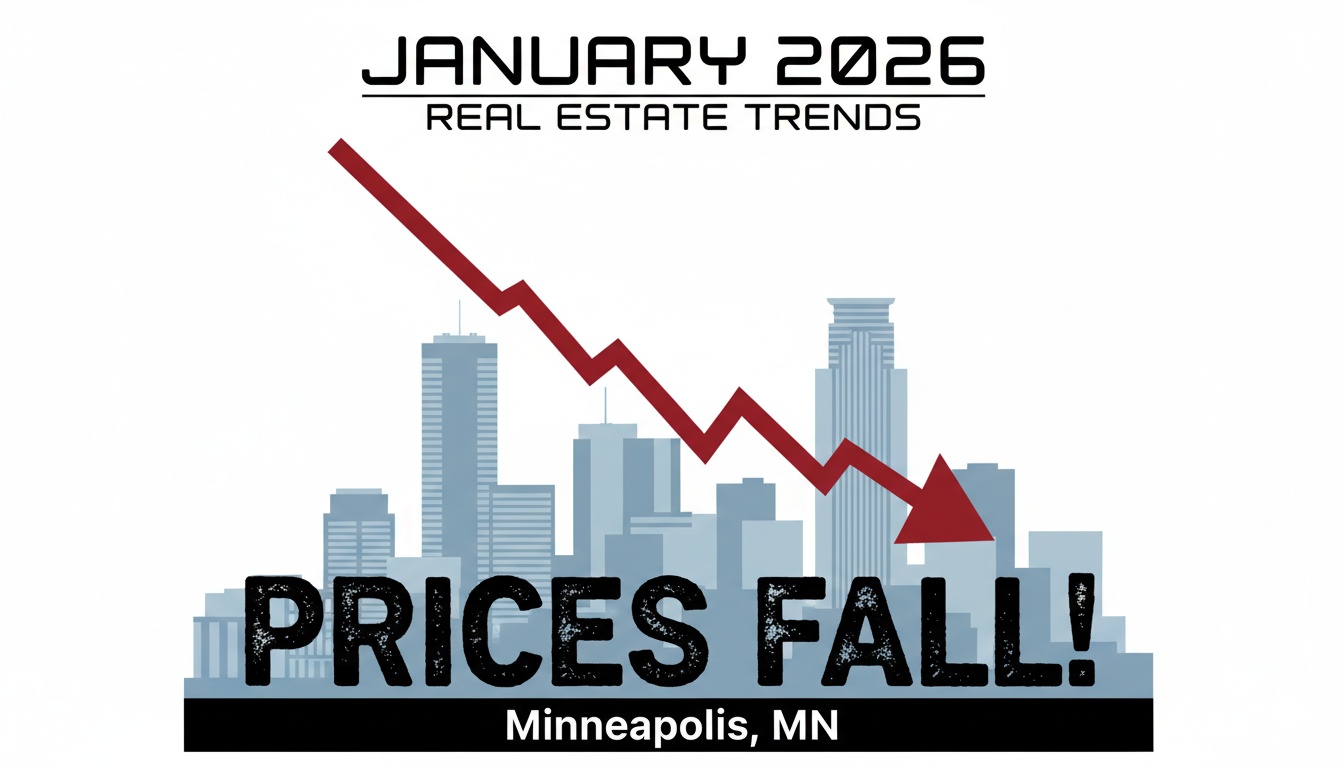
In January 2026, the Minneapolis housing market showed signs of cooling, with median home prices declining year-over-year amid sluggish sales activity and persistent affordability challenges. Closed sales dropped sharply by over 30%, while days on market shortened slightly in some reports, reflecting a more balanced but still constrained environment. Statewide and metro trends pointed to modest price gains overall, but city-specific data highlighted downward pressure on values in Minneapolis proper, driven by reduced buyer demand in lower price segments and ongoing inventory limitations.
Minneapolis Home Prices Dip Amid Slower Start to 2026
The Minneapolis residential real estate market kicked off 2026 with notable softness in key indicators, particularly within city limits. Recent data indicates a year-over-year decline in median sale prices for homes in Minneapolis, contrasting with broader statewide and Twin Cities metro area patterns where prices edged higher.
According to detailed tracking from multiple market observers, the median sale price in Minneapolis reached approximately $315,000 in January 2026, marking a roughly 4.5% drop compared to the same period a year earlier. This pullback stands out against the metro area’s median, which climbed about 1.4% to around $375,000, and the statewide figure rising 1.5% to $335,000. The divergence underscores how city-specific dynamics—such as higher concentration of entry-level and mid-tier properties—are experiencing more pronounced pressure than higher-end or suburban segments.
Several factors contribute to this price softening in Minneapolis. Affordability remains a core barrier for many potential buyers, with stretched household budgets limiting participation despite some stabilization in mortgage rates. Lower demand in the most affordable price brackets has led to fewer pending sales overall, particularly impacting starter homes and properties under $400,000. In contrast, luxury and move-up segments (such as the $700,000–$900,000 range) showed relative resilience, with some areas seeing increased activity from equity-rich buyers.
Sales volume reflected the cautious buyer sentiment. Closed transactions in Minneapolis fell significantly, with reports showing a decline of around 30.5% year-over-year, from roughly 275 homes sold in January of the prior year to about 191 this January. This sharp reduction aligns with statewide trends, where closed sales dropped 15.7%, but the city experienced a steeper pullback—some sources noted over 31% fewer closings in Minneapolis proper.
Market pace showed mixed signals. Homes in Minneapolis sold after an average of about 42 days on market, a noticeable improvement from 56 days the previous year in some datasets, suggesting that well-priced or desirable listings still moved relatively quickly despite overall slowdowns. Other indicators point to homes lingering longer in certain segments, averaging closer to 66 days in broader metro contexts. Sellers generally accepted offers at around 96–97% of list price, a slight improvement in negotiation leverage compared to prior periods, indicating that motivated sellers are adjusting expectations to secure deals.
Inventory levels stayed tight, contributing to the uneven price dynamics. Active listings across the metro saw minimal change year-over-year, with only slight declines or flat activity reported. This persistent supply constraint—months of supply hovering in the low 2-month range metro-wide—continues to support upward pressure in some areas but allows for localized softening where buyer interest wanes. New listings also declined, falling by double digits in the metro, further limiting options for buyers and contributing to the sluggish start.
Neighborhood and property-type variations play a significant role in the city’s trends. Entry-level single-family homes and condos faced the most challenges, with stronger declines in pending sales for affordable segments. Higher-priced properties and certain desirable urban neighborhoods maintained steadier demand, often closing near or above asking in competitive situations. Per-square-foot values held relatively stable, with median figures around $207 showing little change year-over-year.
Broader economic influences, including ongoing concerns over affordability and buyer caution at the start of the year, amplified these shifts. While the market is not in freefall, the January data highlights a transitional phase where price corrections in Minneapolis are emerging amid a larger metro and state backdrop of modest appreciation.
Key Minneapolis Market Metrics – January 2026 (Approximate Year-over-Year Changes)
Median Sale Price : $315,000 (-4.5%)
Homes Sold : 191 (-30.5%)
Days on Market : 42 (improved from prior periods in some tracking)
Sale-to-List Price Ratio : ~96–97% (slight seller concession improvement)
Inventory Trends : Tight, with minimal overall change but localized softness
These figures reflect a market adjusting to current realities, where price declines in the city core highlight opportunities for prepared buyers while underscoring the need for realistic pricing strategies among sellers.
Disclaimer : This is a news and market analysis report based on available real estate data and trends. It is for informational purposes only and not intended as financial, investment, or professional advice.