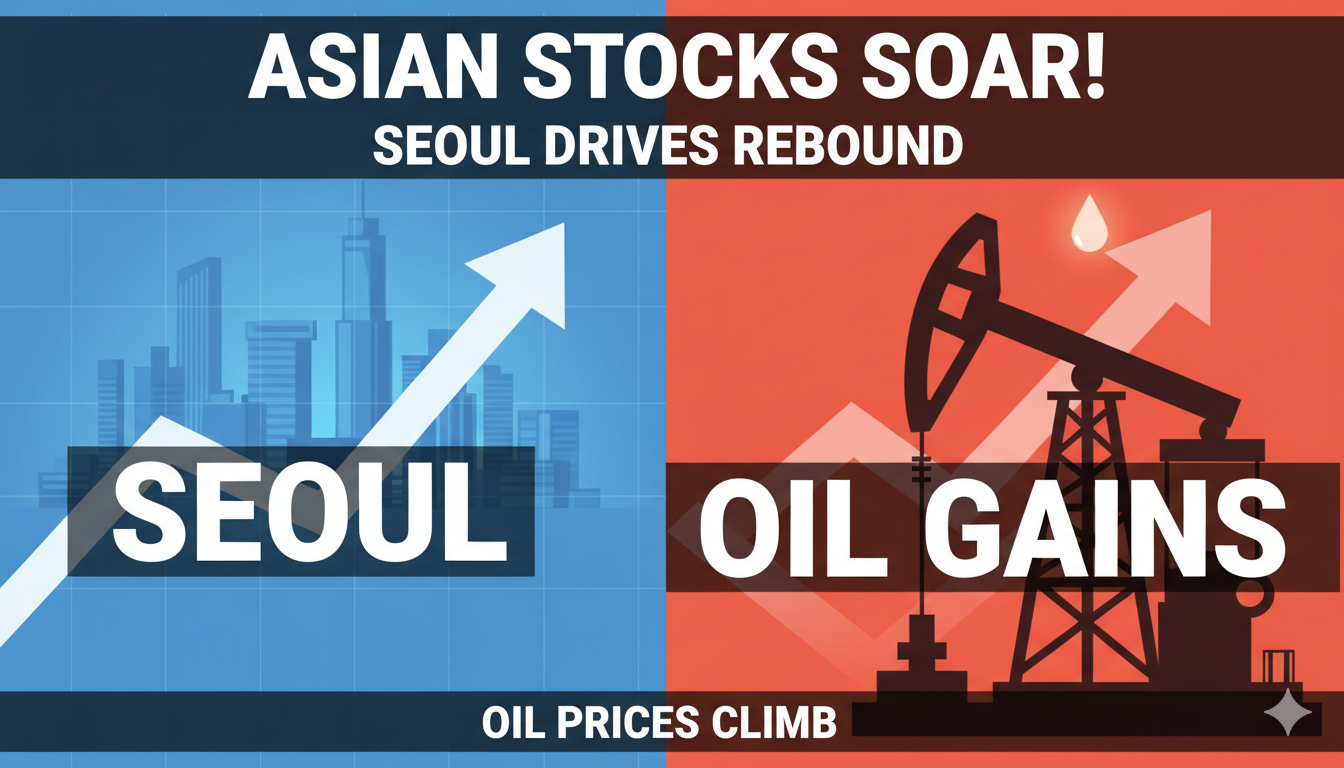
Seoul’s Kospi index led a broad rebound in Asian stocks with gains of up to 12%, recovering from near 20% losses over prior sessions amid bargain buying in chip stocks. Regional indices like Japan’s Nikkei rose around 2%, while oil benchmarks Brent and WTI continued higher, approaching multi-month peaks on Middle East supply concerns despite some market stabilization.
Asian Stocks Rebound Sharply as Risk Sentiment Improves
South Korea’s Kospi index delivered one of the most explosive recoveries in recent market history. After plunging more than 12% the previous day—its worst single-session drop ever—and shedding nearly 20% over the prior few trading days amid panic over energy supply risks, the benchmark roared back. It climbed as high as 12% shortly after the open, triggering temporary trading halts in some components as investors piled into oversold names. By the close, the Kospi stood around 5,583-5,683 levels, posting gains in the 9-10% range depending on final prints.
The surge was powered by South Korea’s export-oriented giants, particularly in the semiconductor sector. Samsung Electronics rallied over 11-14% in various reports, while SK Hynix saw similar double-digit jumps. These stocks had been hammered in the sell-off due to their sensitivity to global growth and energy costs, but dip-buyers viewed the prior weakness as an overreaction. The small-cap Kosdaq index joined the rally, advancing more than 11-14%.
The South Korean government responded swiftly to the volatility. Officials announced emergency economic measures, including a potential 100 trillion won ($68.5 billion) financial package to stabilize markets. President Lee Jae Myung urged activation of support tools to curb excessive swings.
Japan’s Nikkei 225 index also participated in the bounce, rising about 1.9-4.4% across reports, settling near 55,278 after earlier highs. The advance came as bargain hunters stepped in following recent declines, with the market benefiting from positive cues from U.S. equities.
In Hong Kong, the Hang Seng index posted more modest gains of around 0.3%, closing near 25,321. Chinese markets showed resilience, supported by Beijing’s recent policy signals including a 2026 growth target of 4.5-5% and commitments to fiscal stimulus despite tempered expectations.
Broader Asian sentiment improved as Wall Street rebounded overnight, with U.S. stocks recovering ground after oil volatility eased temporarily. Traders appeared to interpret some developments in the Middle East conflict as potentially less escalatory in the short term, though uncertainty lingered.
Oil Prices Push Higher on Supply Disruption Fears
Crude oil benchmarks extended their strong upward momentum, reflecting ongoing concerns over Middle East supply flows amid the widening conflict involving U.S., Israel, and Iran. Brent crude futures climbed more than 2-3%, trading around $83-84 per barrel, approaching peaks not seen since mid-2024. WTI crude rose similarly, moving above $76-77 per barrel, with intraday highs testing recent resistance levels.
The gains built on multi-session advances, with prices up significantly over the past week due to fears of prolonged disruptions to crude exports from the region. Analysts noted that continued choking of supplies could sustain upward pressure, potentially pushing Brent toward $85 or higher if tensions persist. Some forecasts adjusted higher, with institutions eyeing averages in the $74-80 range for early 2026, though extreme scenarios could see spikes to $120+ in prolonged disruptions.
Despite the rally, some stabilization in oil helped equities avoid further damage, as extreme spikes had fueled inflation worries and delayed rate-cut hopes earlier in the week.
Key Market Levels Overview
Kospi: ~5,583-5,683 (+9-10%)
Nikkei 225: ~55,278 (+1.9-2.7%)
Hang Seng: ~25,321 (+0.3%)
Brent Crude: ~$83-84 (+2-3%)
WTI Crude: ~$76-77 (+2-3%)
The rebound highlights the market’s resilience but also its vulnerability to geopolitical shocks. Bargain hunting dominated in oversold sectors, particularly tech in South Korea, while energy markets remained elevated on structural supply risks.
Disclaimer: This is a news and market analysis report based on current observations. It is not investment advice, financial recommendation, or solicitation to buy or sell securities. Markets are volatile and subject to rapid change; always conduct your own research.