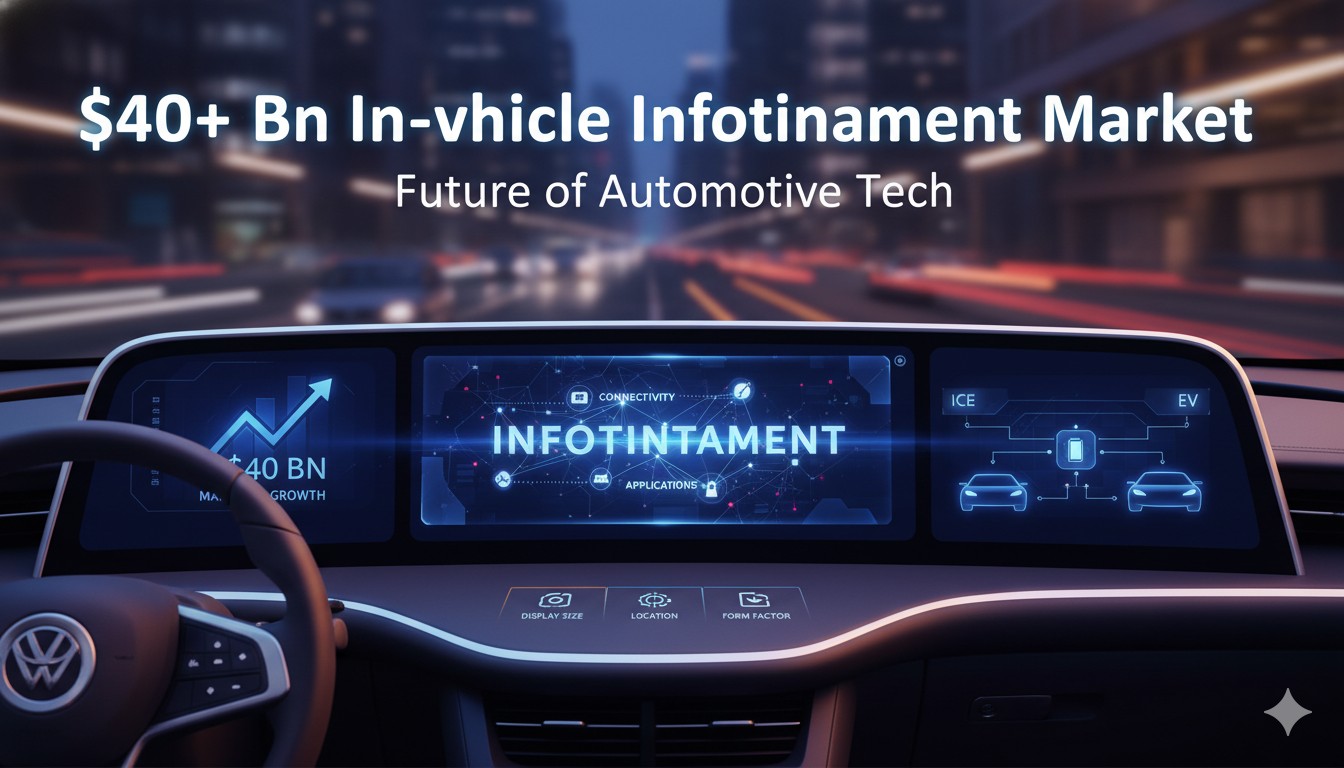
**” The global in-vehicle infotainment market is projected to expand from approximately $23 billion in 2025 to over $40 billion by 2032, driven by an 8.4% compound annual growth rate. Key growth factors include the shift toward Android-based operating systems, rising adoption of 5G connectivity, larger display integrations, and increasing penetration in both internal combustion engine and electric vehicles, particularly in Asia Pacific. “**
In-Vehicle Infotainment Market Surges Toward $40 Billion Milestone Amid Software-Defined Vehicle Revolution
The in-vehicle infotainment (IVI) sector continues to evolve as a core element of modern automotive design, blending entertainment, navigation, communication, and vehicle control interfaces into unified digital cockpits. Current market dynamics show strong momentum, with the sector valued at around $23.07 billion in 2025 and forecasted to reach $40.49 billion by 2032, achieving a steady 8.4% CAGR over the period.
This expansion stems from several converging trends. Automakers are prioritizing software-defined vehicles (SDVs), where zonal architectures and high-bandwidth Ethernet backbones enable integrated systems that combine infotainment with advanced driver-assistance systems (ADAS) and powertrain functions. Over-the-air (OTA) updates have become standard, allowing continuous feature enhancements without hardware changes, while app ecosystems and containerized user experiences shorten development cycles and open new revenue streams through subscriptions.
Component Breakdown The market segments by component reveal hardware still dominates in volume, but software gains traction for its scalability. Infotainment units form the backbone, incorporating processors, memory, and interfaces. Display units, including touchscreens and digital instrument clusters, drive much of the recent growth as screen sizes increase. Head-up displays (HUDs) and passenger displays add premium appeal, especially in higher-end models, while audio units and navigation modules remain essential.
Key components include:
Infotainment units
Head-up displays
Passenger displays
Digital instrument clusters
Hardware components lead overall share due to physical integration requirements, but software layers enable differentiation through updates and personalization.
Applications Driving Adoption Applications span core functions that enhance daily driving. Navigation remains a top priority, with real-time traffic, route optimization, and integration of mapping services. Virtual personal assistants (VPAs) leverage voice recognition and AI for hands-free control of climate, media, and queries. App stores allow third-party integrations for streaming, productivity, and gaming. Music and rear-seat entertainment cater to passenger comfort, particularly in family-oriented or long-haul vehicles.
Operating Systems Landscape Android emerges as the fastest-growing OS segment, benefiting from its open-source nature, cost efficiency, and robust ecosystem support. Automakers increasingly adopt Android Automotive OS for flexible, app-rich interfaces that support seamless smartphone mirroring and OTA capabilities. Linux and QNX hold positions in embedded systems for reliability, while other proprietary options persist in legacy or specialized applications. The Android segment’s rise accelerates due to partnerships between OEMs, Tier-1 suppliers, and tech providers.
Connectivity Evolution Connectivity types shift decisively toward advanced standards. 5G adoption accelerates low-latency, high-bandwidth applications such as real-time streaming, cloud-based processing, and vehicle-to-everything (V2X) communication. Earlier 3G/4G setups still serve base models, but 5G enables immersive experiences like augmented reality navigation and over-the-air feature unlocks.
Form Factor and Display Size Trends Form factors include embedded (fully integrated), tethered (smartphone-dependent), and integrated (hybrid) setups. Embedded systems gain favor for reliability and control. Display sizes trend upward, with >10-inch screens becoming common in mid- and premium segments for richer interfaces, while 5–10-inch units dominate economy models. Smaller <5-inch displays fade in new installations.
Location Preferences Front-row systems prioritize driver-centric features like navigation and controls, maintaining the largest share. Rear-row installations grow, especially for entertainment in SUVs, minivans, and luxury vehicles, supporting passenger streaming and gaming.
ICE vs. EV Differentiation Internal combustion engine (ICE) vehicles still represent the majority of installations, particularly in passenger cars and commercial segments. Electric vehicles (EVs), including battery electric, plug-in hybrid, and fuel cell types, demand more sophisticated IVI due to unique needs like battery monitoring, range optimization, and charging station integration. EVs accelerate adoption of larger screens and advanced connectivity.
Regional Dynamics Asia Pacific stands as the largest and fastest-growing region, fueled by high passenger car production volumes in China, India, Japan, and South Korea. Economy and mid-range models feature 5–10-inch displays, while rapid EV penetration boosts demand for connected features. North America and Europe emphasize premium integrations, including digital clusters and HUDs in SUVs and luxury segments, with strong focus on cybersecurity and regulatory compliance.
The market’s trajectory points to continued innovation, with software platforms, AI personalization, and 5G infrastructure reshaping the in-cabin experience across vehicle types and geographies.
Disclaimer: This is a news and analysis report based on industry trends and projections. It is for informational purposes only and does not constitute financial, investment, or purchasing advice.