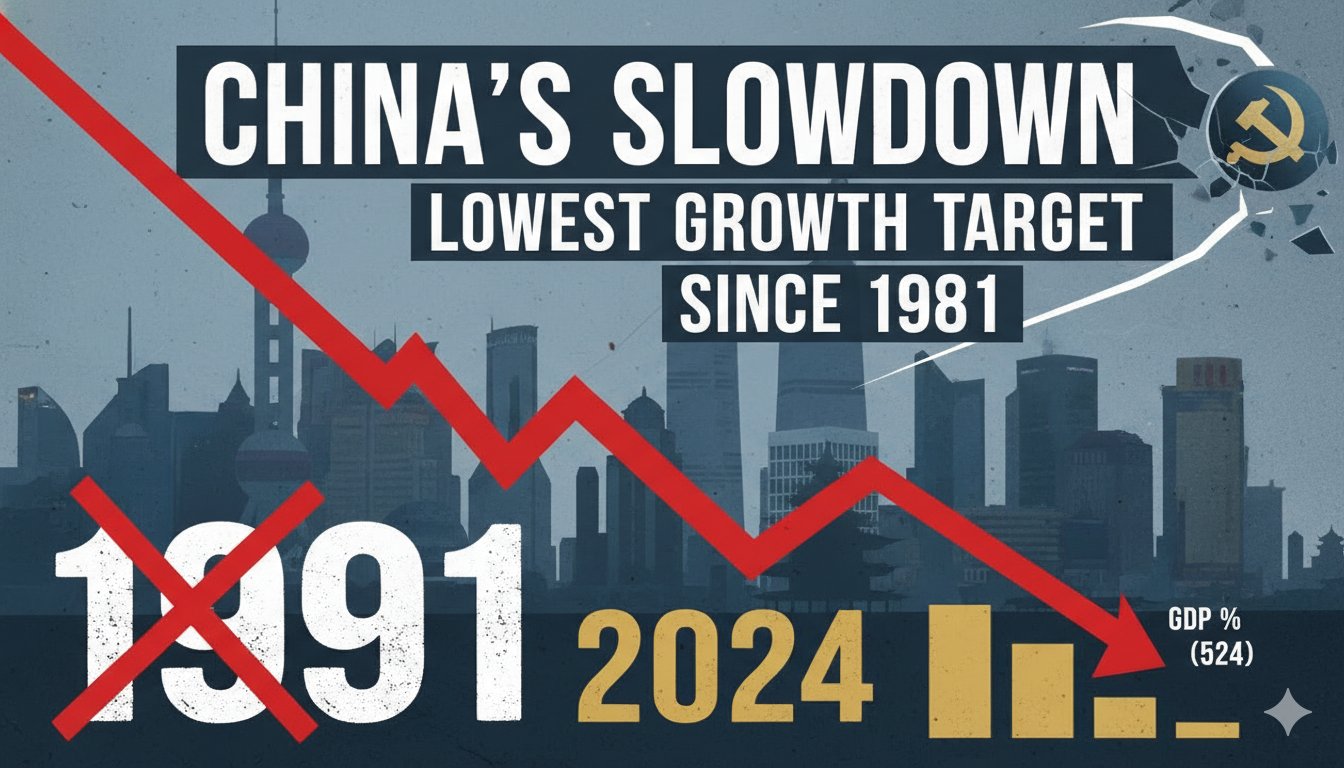
China has officially set its GDP growth target for 2026 at 4.5% to 5%, marking the most modest goal since 1991 and the first downgrade below 5% in over three decades. This pragmatic shift acknowledges persistent domestic challenges like a prolonged property slump, weak consumption, deflationary pressures, and external headwinds including U.S. trade tensions. While Beijing achieved 5% growth in 2025, the lower ambition signals a tolerance for slower expansion as policymakers prioritize high-quality, sustainable development over rapid pace, with plans to boost consumption, innovation, and new growth drivers amid a complex global landscape.
China’s Historic Downgrade in Growth Ambitions
Chinese Premier Li Qiang announced the 4.5% to 5% GDP growth target during his government work report at the opening of the National People’s Congress, the annual “Two Sessions” gathering in Beijing. This represents a clear departure from the “around 5%” benchmark maintained from 2023 through 2025, during which the economy delivered exactly 5% expansion last year, pushing total GDP to approximately 140 trillion yuan (about $20 trillion).
The decision reflects Beijing’s recognition that the old growth model—reliant on heavy investment, exports, and property development—is under severe strain. For decades, China pursued double-digit or high-single-digit growth, but structural shifts have made such rates increasingly unsustainable. The last time a target dipped this low was in the early 1990s, amid post-Tiananmen economic adjustments and global uncertainties.
Key economic indicators underscore the rationale for caution. In 2025, while full-year growth hit the target, momentum faded sharply in the final quarter, dropping to around 4.5%. Domestic consumption remains subdued, with household spending hampered by falling home prices, high youth unemployment, and lingering effects of the property crisis that has eroded wealth and confidence. Deflationary pressures persist, as producer prices continue to decline and consumer inflation hovers near zero.
Externally, escalating trade frictions add pressure. U.S. tariffs on Chinese goods have intensified, prompting Beijing to diversify export markets and focus inward. Geopolitical tensions and a slowing global economy further complicate the outlook, making export-led recovery less reliable.
Fiscal and Monetary Policy Adjustments
To support the tempered growth objective, authorities have outlined supportive measures without resorting to massive stimulus that could exacerbate imbalances.
Budget Deficit : Set at around 4% of GDP, maintaining elevated levels to fund infrastructure and social programs.
Inflation Target : Around 2%, reflecting expectations of mild price recovery.
Urban Unemployment : Around 5.5%, acknowledging ongoing job market challenges, particularly for young graduates.
Policymakers emphasize boosting domestic demand as the top priority. Efforts include expanding consumer goods trade-in programs, increasing support for low-income households, and promoting service-sector growth. Innovation in high-tech areas—such as artificial intelligence, green energy, and advanced manufacturing—remains central, with commitments to nurture “new productive forces” for long-term competitiveness.
Challenges in the Property Sector and Consumption
The property market continues to weigh heavily. Years of overbuilding and developer debt issues have led to tumbling home prices, unfinished projects, and reduced household wealth. This has suppressed consumption, which accounts for a smaller share of GDP compared to developed economies.
Investment confidence has also suffered, with private sector activity lagging. While exports provided a buffer in 2025, potential further tariff hikes threaten that cushion.
Implications for Global Markets
For U.S. investors and businesses, this lower target suggests a more restrained Chinese economy, potentially easing some competitive pressures in global supply chains but also signaling reduced demand for commodities and luxury goods. It may prompt multinational firms to accelerate diversification away from China-centric models.
Beijing’s approach indicates a strategic pivot toward resilience over speed. By accepting slower growth, leaders aim to avoid policy overreach that could fuel debt or bubbles. The focus on consumption rebalancing and technological self-reliance could yield more stable expansion in the medium term, though short-term headwinds remain formidable.
Some economists view the 4.5%-5% range as still ambitious given current dynamics, predicting it may require aggressive reforms to achieve. Others see it as pragmatic realism, allowing flexibility for targeted interventions without overcommitting resources.
Broader Economic Targets Overview
| Target | 2026 Goal | Comparison to Prior Years |
|---|---|---|
| GDP Growth | 4.5% – 5% | Lowest since 1991; down from ~5% (2023-2025) |
| Budget Deficit | ~4% of GDP | Elevated to support spending |
| Inflation (CPI) | ~2% | Mild recovery expected |
| Urban Unemployment | ~5.5% | Reflects structural job pressures |
| New Urban Jobs | Not specified | Emphasis on quality employment |
This framework positions China for a transitional phase, where quality trumps quantity in growth metrics. The coming year will test Beijing’s ability to navigate domestic reforms while managing external risks, with implications for global economic stability.
Disclaimer: This is a news analysis piece based on publicly reported economic developments and official announcements. It is for informational purposes only and does not constitute financial advice, investment recommendation, or endorsement of any policy.