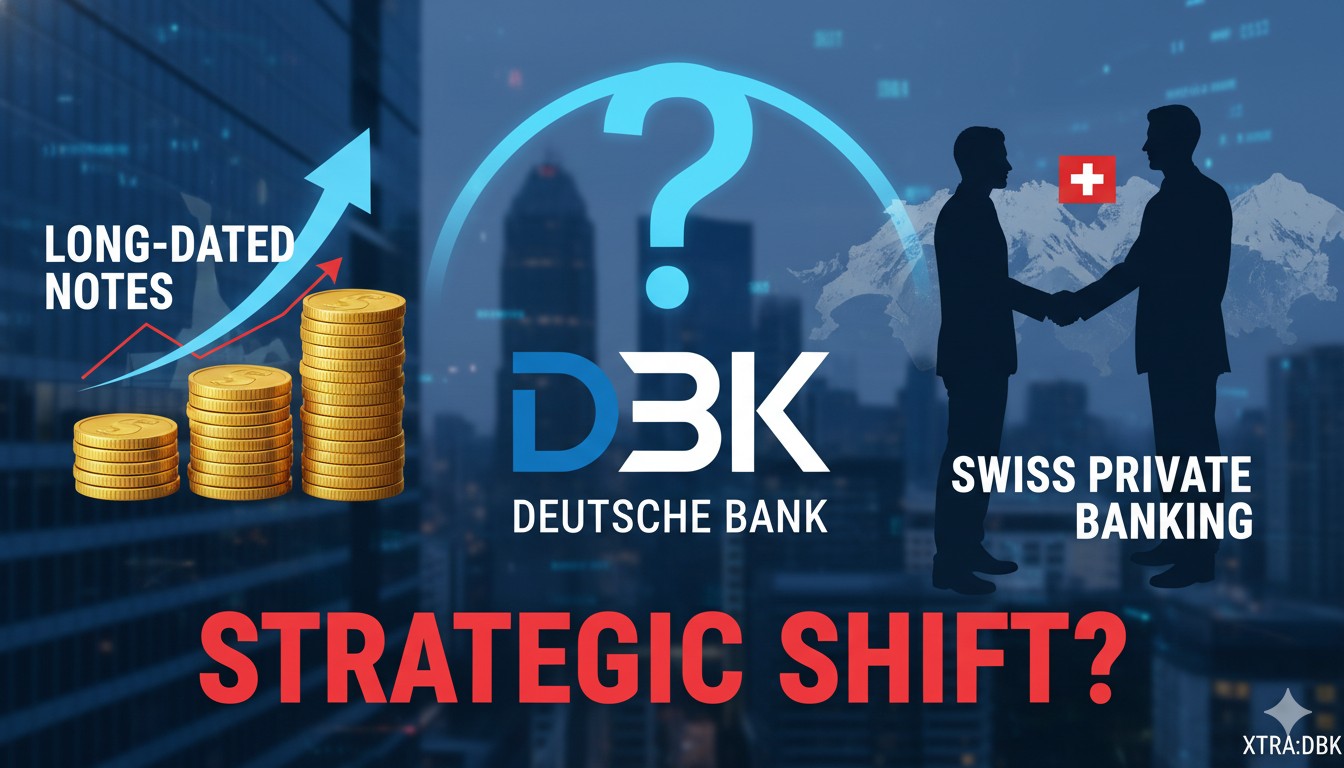
“Deutsche Bank’s recent long-dated note issuances signal enhanced funding flexibility and market confidence in its long-term viability, while key hires in Swiss private banking bolster its wealth management expansion, potentially reshaping its narrative from transformation to sustained growth as a leading European player.”
Deutsche Bank has ramped up its issuance of long-dated senior notes, including a series of U.S. dollar-denominated fixed-rate, callable senior unsecured offerings with maturities extending to 2031 and beyond. This move underscores the bank’s ability to tap capital markets for extended funding, reflecting investor appetite for its debt amid a backdrop of economic resilience and AI-driven growth prospects. The issuances, which include landmark euro-denominated tier two bonds with durations exceeding 15 years, provide downside protection for equity holders and enhance the bank’s capital structure. By securing these funds at competitive rates, Deutsche Bank is positioning itself to weather potential volatility from geopolitical risks and trade uncertainties, while funding initiatives in high-growth areas like wealth management.
In parallel, the bank has made strategic hires in its Swiss private banking operations, including the appointment of Clemens Kaiser as Chief Country Officer for Switzerland and CEO of Deutsche Bank (Suisse) SA. This follows the addition of experienced duo Yunus Ömer and David Zajdman in Zurich, along with other talent from competitors to strengthen advisory services for ultra-high-net-worth clients. These personnel moves align with a broader plan to recruit up to 250 wealth managers globally, with a focus on Europe, including Switzerland, to accelerate asset gathering and client activation. The emphasis on Swiss operations leverages the region’s reputation for stability and discretion, aiming to double discretionary portfolio management assets and achieve revenue growth exceeding 5-6% annually in the wealth unit.
These developments could alter Deutsche Bank’s strategic narrative, evolving from a period of restructuring and cost discipline to one emphasizing organic growth and market leadership. The long-dated notes demonstrate restored credibility in fixed income markets, allowing the bank to pursue ambitious targets like an 8% compound annual growth rate in client assets through 2028. Meanwhile, the Swiss hires support a push into affluent and entrepreneurial client segments, potentially diversifying revenue away from cyclical investment banking toward more predictable fee-based income from private banking.
Key Financial Metrics and Performance
Deutsche Bank’s stock (NYSE:DB) trades around $39.26, reflecting a year-to-date gain amid broader market optimism. The bank’s strategy for 2026-2028 includes plans to boost shareholder payouts to 60% from 50%, signaling confidence in profitability and capital returns.
Implications for Investors
| Metric | Value | Notes |
|---|---|---|
| Current Share Price (NYSE:DB) | $39.26 | Midpoint between bid and ask |
| Market Capitalization | Approximately $77 billion | Based on outstanding shares |
| Price-to-Earnings Ratio (TTM) | 13.42 | Indicating valuation relative to earnings |
| 52-Week High/Low | $39.80 / $20.50 | Showing recent peak performance |
| Beta (5Y Monthly) | 1.07 | Moderate market sensitivity |
Funding Strategy Evolution : The wave of long-dated issuances reduces near-term refinancing risks and supports investments in digital propositions for European clients, potentially improving return on tangible equity.
Wealth Management Momentum : Hires in Switzerland target underserved markets like family offices and cross-border wealth, aligning with goals to explore inorganic opportunities and enhance advisory engagement.
Risk Considerations : While these steps fortify the balance sheet, exposure to European economic rebounds—fueled by fiscal stimuli—and global AI adoption could amplify volatility if trade policies disrupt growth.
Competitive Positioning : As a aspiring European champion, Deutsche Bank aims to capitalize on disruptions in the wealth sector, monetizing turmoil through targeted hiring in key hubs like Switzerland.
The interplay of these elements suggests a narrative shift toward resilience and expansion, with wealth management emerging as a core pillar alongside strengthened capital markets access.
Disclaimer: This news report is for informational purposes only and does not constitute investment advice, tips, or recommendations.